3D-Objects of constant width 3D-Objekte mit konstantem Durchmesser
Not just the ball! Nicht nur die Kugel!
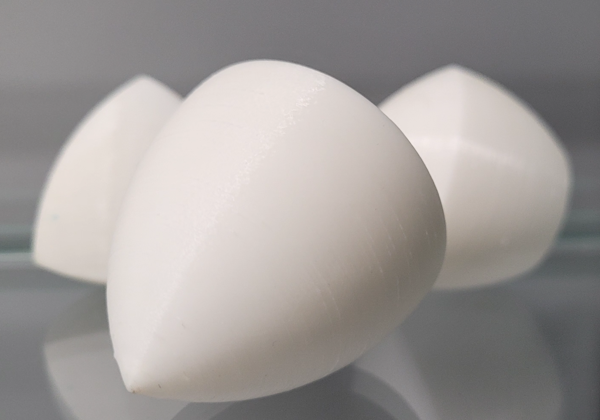
Take a ball and place it between two parallel plates. The distance between the plates equals the diameter of the ball — and it stays the same no matter how you rotate the ball. This is hardly surprising: after all, a ball looks the same from every direction.
Now here is the surprising part: the ball is not the only 3D object with this property. There exist many other convex bodies — with edges, corners, and flat regions — that also fit snugly between two parallel plates at exactly the same distance, no matter how they are turned. These are called bodies of constant width.
What does "constant width" mean?
The width of a convex body in a given direction is the distance between two parallel supporting planes perpendicular to that direction. A body of constant width \(w\) is a convex body whose width is the same value \(w\) in every direction.
Equivalently: if you place the object on a flat table and push a flat plate down from above, the gap between table and plate is always \(w\), regardless of how the object is oriented.
The 2D case: Reuleaux triangles
The idea is easiest to understand in two dimensions first. A circle has constant width — that is obvious. But so does the Reuleaux triangle: start with an equilateral triangle and replace each side by a circular arc centred at the opposite vertex. The resulting shape has constant width equal to the side length of the original triangle. You can verify this with a ruler: no matter how you orient the Reuleaux triangle between two parallel lines, the distance between the lines is always the same.
This is the reason why manhole covers could, in principle, be Reuleaux triangles — they would not fall through the hole, just like circular covers.
From 2D to 3D
The objects in the cabinet are three-dimensional versions of the same idea. One classical construction starts from a regular tetrahedron: replace each edge by a surface of revolution (a spindle) and smooth the result to obtain a body of constant width. This construction goes back to Ernst Meissner (1911), and the resulting shapes are called Meissner bodies (or Meissner tetrahedra).
More generally, there are infinitely many bodies of constant width in every dimension. In 2D, they can be obtained by intersecting finitely many disks. In 3D, the constructions are more intricate, but the principle remains: every body of constant width \(w\) can roll smoothly between two parallel plates separated by distance \(w\).
A surprising theorem
One might wonder: among all bodies of constant width \(w\), which one has the smallest volume? In 2D, the answer is the Reuleaux triangle (this is the Blaschke–Lebesgue theorem). In 3D, the answer was unknown for more than a century — until 2024, when it was proved that a Meissner body minimizes volume among all 3D bodies of constant width.
Try it yourself
Pick up one of the objects in the cabinet and roll it between your hands held flat. You will feel that the distance between your hands does not change — even though the object is clearly not a ball. This is a fact you have to experience to truly believe.
Further Reading
Nehmen wir eine Kugel und legen sie zwischen zwei parallele Platten. Der Abstand zwischen den Platten entspricht dem Durchmesser der Kugel — und er bleibt gleich, egal wie man die Kugel dreht. Das ist kaum überraschend: eine Kugel sieht schließlich aus jeder Richtung gleich aus.
Nun kommt der überraschende Teil: Die Kugel ist nicht das einzige 3D-Objekt mit dieser Eigenschaft. Es gibt viele andere konvexe Körper — mit Kanten, Ecken und flachen Bereichen —, die ebenfalls genau mit dem gleichen Abstand zwischen zwei parallele Platten passen, egal wie sie gedreht werden. Diese nennt man Körper konstanter Breite (oder konstanten Durchmessers).
Was bedeutet „konstante Breite"?
Die Breite eines konvexen Körpers in einer gegebenen Richtung ist der Abstand zwischen zwei parallelen Stützebenen senkrecht zu dieser Richtung. Ein Körper konstanter Breite \(w\) ist ein konvexer Körper, dessen Breite in jeder Richtung denselben Wert \(w\) hat.
Äquivalent: Legt man das Objekt auf einen flachen Tisch und drückt von oben eine flache Platte herunter, ist der Spalt zwischen Tisch und Platte immer \(w\), unabhängig von der Orientierung des Objekts.
Der 2D-Fall: Reuleaux-Dreiecke
Die Idee lässt sich am einfachsten zunächst in zwei Dimensionen verstehen. Ein Kreis hat konstante Breite — das ist offensichtlich. Aber auch das Reuleaux-Dreieck: Man beginne mit einem gleichseitigen Dreieck und ersetze jede Seite durch einen Kreisbogen, dessen Mittelpunkt die gegenüberliegende Ecke ist. Die resultierende Form hat konstante Breite gleich der Seitenlänge des ursprünglichen Dreiecks. Man kann dies mit einem Lineal überprüfen: Egal wie man das Reuleaux-Dreieck zwischen zwei parallelen Linien orientiert, der Abstand zwischen den Linien ist immer gleich.
Deshalb könnten Kanaldeckel im Prinzip Reuleaux-Dreiecke sein — sie würden nicht durch das Loch fallen, genau wie kreisförmige Deckel.
Von 2D nach 3D
Die Objekte im Kabinett sind dreidimensionale Versionen derselben Idee. Eine klassische Konstruktion beginnt mit einem regulären Tetraeder: Man ersetzt jede Kante durch eine Rotationsfläche (eine Spindel) und glättet das Ergebnis, um einen Körper konstanter Breite zu erhalten. Diese Konstruktion geht auf Ernst Meissner (1911) zurück, und die resultierenden Formen heißen Meissner-Körper (oder Meissner-Tetraeder).
Allgemeiner gibt es in jeder Dimension unendlich viele Körper konstanter Breite. In 2D können sie durch Schnitt endlich vieler Kreisscheiben erzeugt werden. In 3D sind die Konstruktionen aufwendiger, aber das Prinzip bleibt: Jeder Körper konstanter Breite \(w\) kann gleichmäßig zwischen zwei parallelen Platten im Abstand \(w\) rollen.
Ein überraschendes Theorem
Man könnte sich fragen: Welcher unter allen Körpern konstanter Breite \(w\) hat das kleinste Volumen? In 2D ist die Antwort das Reuleaux-Dreieck (dies ist der Satz von Blaschke–Lebesgue). In 3D war die Antwort über ein Jahrhundert lang unbekannt — bis 2024 bewiesen wurde, dass ein Meissner-Körper das Volumen unter allen 3D-Körpern konstanter Breite minimiert.
Selbst ausprobieren
Nehmen Sie eines der Objekte im Kabinett und rollen Sie es zwischen Ihren flach gehaltenen Händen. Sie werden spüren, dass sich der Abstand zwischen Ihren Händen nicht ändert — obwohl das Objekt offensichtlich keine Kugel ist. Das ist eine Tatsache, die man selbst erleben muss, um sie wirklich zu glauben.
Weiterführende Literatur