Good polytopes and better polytopes from the nature Gute Polytope und bessere Polytope aus der Natur
leider nur in dimension 3
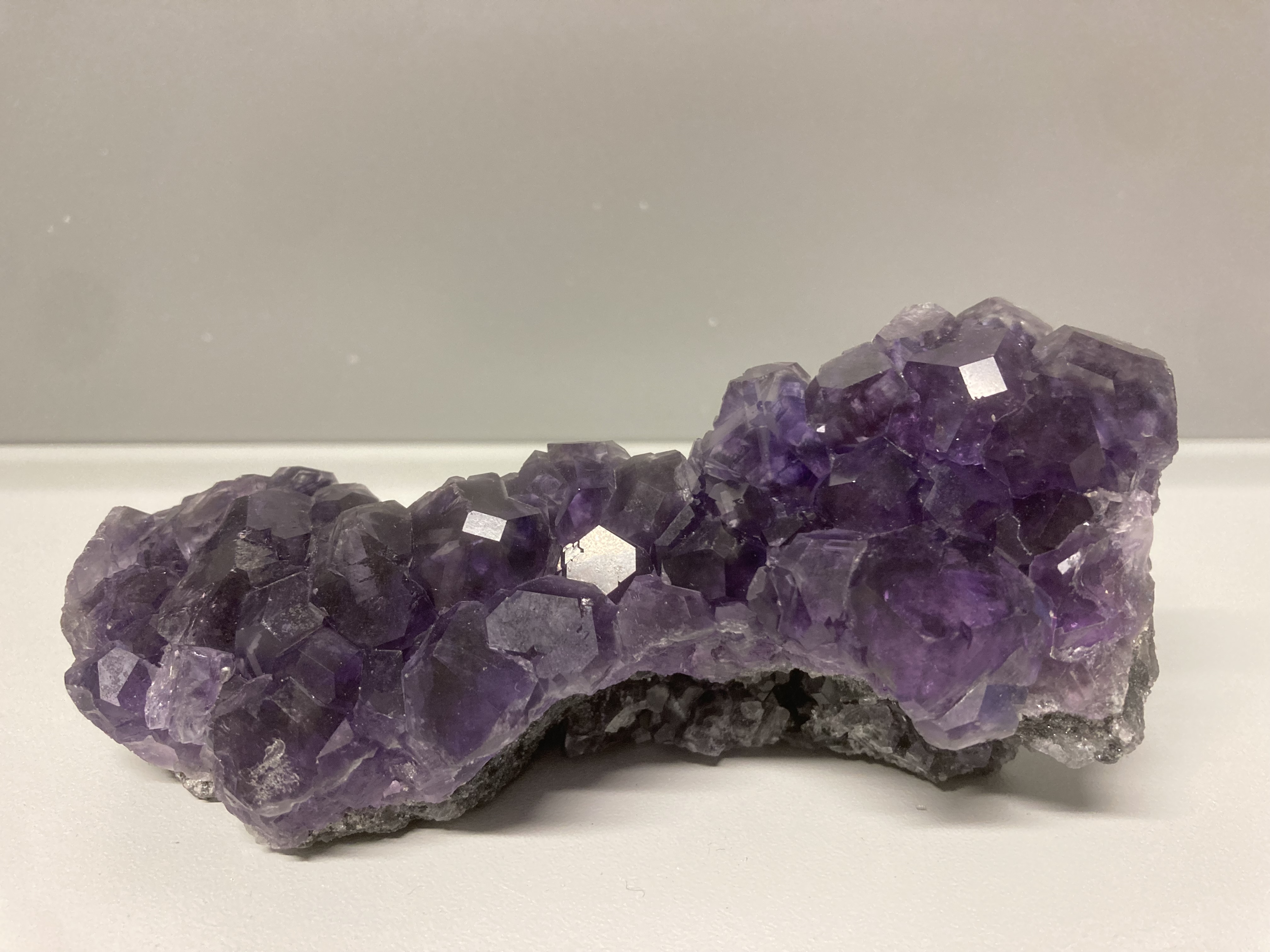 These are fluorite crystals. The local structure formed by Ca$^{2+}$ and F$^-$ ensures that the normal vectors of the facets of a fluorite crystal are the $A_3$ roots. Thus fluorite crystals form $3$-dimensional generalized permutohedra which can be observed in nature (unfortunately, only $3$-dimensional). Most natural fluorite crystals are of cubical or octahedral shape, these are relatively rare crystals of perfect permutohedral shape. Permutohedra are the beloved polytopes by many of us. The permutohedral geometry is responsible for many combinatorial phenomena, for example, log-concavity of characteristic polynomials, conditional independence structures.
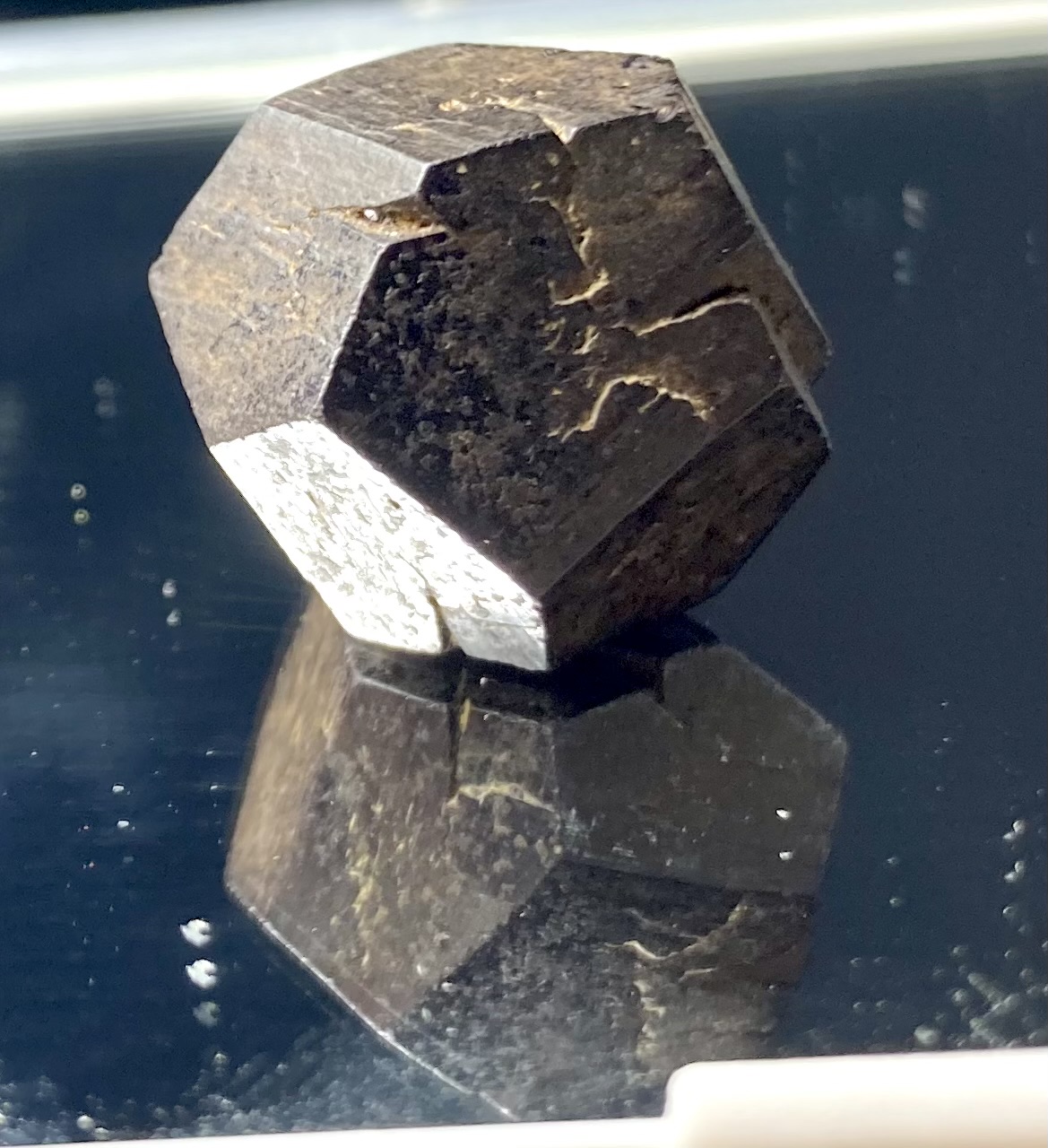
However, sometimes there are polytopes which are even better than permutohedra. Permutohedra are space-filling, that is, $\mathbb{R}^n$ can be tiled by translated copies of an $n$-dimensional permutohedron. Motivated by physics, it is natural to look for a subdivision of the space into cells of equal volume with minimal surface area. In dimension $2$, this is the honeycomb theorem which states that the tiling by permutohedra (regular hexagons) is the optimal tiling and was conjectured by Marcus Terentius Varro in 36 BC, proved by Thomas Callister Hales in 1999 AD. In 1887, Lord Kelvin asked the corresponding question for three-dimensional space: how can $\mathbb{R}^3$ be partitioned into cells of equal volume with the least area of surface between them? Or in short, what was the most efficient soap bubble foam? The Kelvin conjecture states that the foam of the permutohedral tiling of $\mathbb{R}^3$ is the most efficient foam. This conjecture was widely believed to be true for more than a century until it was disproved by Denis Weaire and Robert Phelan in 1993. They constructed a counterexample to the Kelvin conjecture called the Weaire-Phelan structure. It is the foam of a tiling of $\mathbb{R}^3$ by pyritohedron and truncated hexagonal trapezohedron. A pyritohedron appears again as a natural pyrite crystal (much rarer than a cube). There is no regular dodecahedral crystal in nature because the $H_3$ root system is not crystallographic, the pyritohedron is a polytope which is combinatorially equivalent to the regular dodecahedron.
Sometimes, natural science gives great motivation and inspiration to mathematics.
Die sind Kristalle von Fluorit (Flussspat). Die lokale Struktur von Ca$^{2+}$ und F$^-$ erzwingt, dass die Normalvektoren der Facetten eines Flussspatkristalls $A_3$ Wurzeln sind. Daher formen die Flussspatkristalle die in der Natur beobachtbaren $3$-dimensionalen verallgemeinerten Permutaeder (leider nur $3$-dimensional). Zwar sind meisten Flussspatkristalle kubisch oder oktaedrisch, diese hier sind relativ seltene perfekt permutaedrische Kristalle. Permutaeder sind die beliebtesten Polytope. Die permutaedrische Geometrie ist für viele kombinatorische Phänomene verantwortlich, z.B. die Logkonkavität der characteristischen Polynome, die bedingten Unabhängigkeitsstrukturen.
Allerdings gibt es manchmal Polytope, die noch besser sind als Permutaeder. Permutaeder sind raumfüllend, das heißt, $\mathbb{R}^n$ lässt sich durch die verschobenen Kopien eines $n$-dimensionalen Permutaeders parkettieren. Physikalisch motiviert ist es natürlich, eine Parkettierung des Raums mit Zellen von gleichem Volumen und minimalem Oberflächeninhalt. In Dimension $2$ ist es der Bienenwaben-Satz (https://de.wikipedia.org/wiki/Bienenwaben-Satz), welcher besagt, dass die Parkettierung durch Permutaeder (regelmäßige Sechsecke) optimal ist, wurde spätestens 36 v. Chr. von Marcus Terentius Varro vermutet und 1999 n. Chr. von Thomas Callister Hales bewiesen. Die entsprechende Frage für Dimension 3 wurde 1887 von Lord Kelvin gestellt: Welche Parkettierung von $\mathbb{R}^3$ mit Zellen von gleichem Volumen hat den kleinsten Flächeninhalt der Zwischenfläche? Oder kurz gesagt, what was the most efficient soap bubble foam? Die Kelvins Vermutung besagt, dass der Schaum der permutaedrischen Parkettierung von $\mathbb{R}^3$ bestmöglich ist. Kelvin und die meisten Leute waren davon überzeugt bis zur Widerlegung von Denis Weaire und Robert Phelan in 1993. Sie haben ein Gegenbeispiel, die sogenannte Weaire-Phelan-Struktur konstruiert. Das ist der Schaum aus der Parkettierung von $\mathbb{R}^3$ mit Pyritoedern und abgestumpften sechseckigen Trapezoedern. Das Pyritoeder kommt wieder in der Natur als Kristall von Pyrit vor (allerdings seltener als Würfel). Es gibt keine regelmäßig dodekaedrischen Kristalle in der Natur, weil das $H_3$ Wurzelsystem nicht kristallographisch ist. Das Pyritoeder ist aber ein zu dem regelmäßigen Dodekaeder kombinatorisch äquivalentes Polytop.
Manchmal bekommt Mathematik Motivation und Inspiration aus den Naturwissenschaften.