Klein bottle Kleinsche Flasche
A non-orientable surface that cannot be embedded in three-dimensional space Eine nicht-orientierbare Fläche, die sich nicht in den dreidimensionalen Raum einbetten lässt
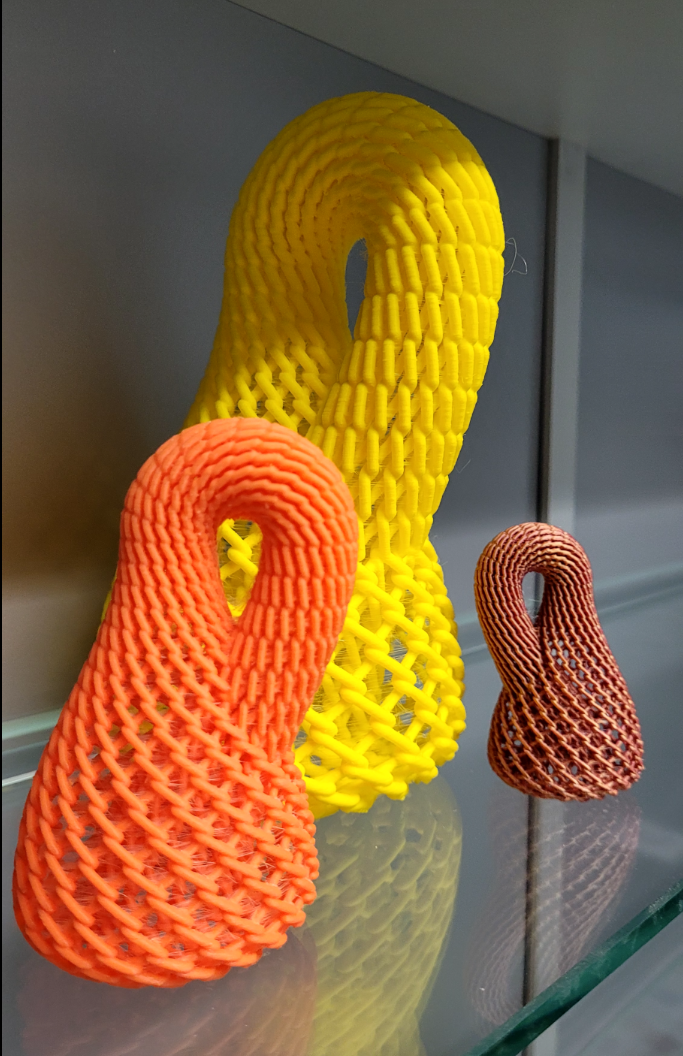
The Klein bottle, first described by the German mathematician Felix Klein in 1882, is one of the most iconic objects in topology. It is a closed surface — like a sphere or a torus — but with the remarkable property that it is non-orientable: it has no well-defined "inside" or "outside."
To understand what this means, imagine an ant walking along the surface. On a sphere, the ant always stays on the same side. On a Klein bottle, the ant can walk along the surface and return to its starting point on the opposite side — without ever crossing an edge. This is the same phenomenon that occurs on a Möbius strip, but while the Möbius strip is a surface with boundary, the Klein bottle is a closed surface without boundary.
How to build a Klein bottle
A Klein bottle can be described by a simple gluing construction. Start with a square and identify (glue) opposite edges: glue the top edge to the bottom edge going in the same direction (as for a cylinder), and glue the left edge to the right edge going in opposite directions (as for a Möbius strip).
In symbols, this identification space is the quotient of the unit square \([0,1] \times [0,1]\) under the relations
- \((x, 0) \sim (x, 1)\) for all \(x\) (same direction — like a torus), and
- \((0, y) \sim (1, 1-y)\) for all \(y\) (opposite direction — like a Möbius strip).
If both pairs of edges were glued in the same direction, we would get a torus. The reversal in the second gluing is what makes the Klein bottle non-orientable.
Why it cannot live in 3D
A true Klein bottle is a two-dimensional surface that can only be properly embedded in four-dimensional space. In three dimensions, any physical model must have a self-intersection — the tube that passes through itself, visible in every glass Klein bottle. Mathematically, the 3D models we see are immersions, not embeddings: the surface crosses itself, but this intersection is an artefact of the lower-dimensional representation.
This is analogous to how a Möbius strip can be drawn in the plane only with crossings, but lives without crossings in three-dimensional space.
| Property | Value |
|---|---|
| Euler characteristic | 0 |
| Genus (non-orientable) | 2 |
| Minimum embedding dimension | 4 |
| Fundamental group | \(\langle a, b \mid abab^{-1} \rangle\) |
| First homology | \(\mathbb{Z} \oplus \mathbb{Z}/2\mathbb{Z}\) |
Relationship to other surfaces
The Klein bottle sits in a beautiful classification of closed surfaces:
- Every closed, orientable surface is a sphere with handles — a sphere (genus 0), a torus (genus 1), a double torus (genus 2), and so on.
- Every closed, non-orientable surface is a sphere with crosscaps — a projective plane (1 crosscap), a Klein bottle (2 crosscaps), and so on.
In fact, the Klein bottle is topologically equivalent to two Möbius strips glued along their boundary. This decomposition is itself a beautiful and non-trivial result. The Klein bottle also arises as the connected sum of two real projective planes: \(K \cong \mathbb{R}P^2 \# \mathbb{R}P^2\).
Further Reading
Die Kleinsche Flasche, erstmals 1882 vom deutschen Mathematiker Felix Klein beschrieben, ist eines der ikonischsten Objekte der Topologie. Sie ist eine geschlossene Fläche — wie eine Sphäre oder ein Torus — aber mit der bemerkenswerten Eigenschaft, dass sie nicht-orientierbar ist: sie hat keine wohldefinierte „Innen-" oder „Außenseite."
Um zu verstehen, was das bedeutet, stelle man sich eine Ameise vor, die auf der Fläche entlangläuft. Auf einer Sphäre bleibt die Ameise immer auf derselben Seite. Auf einer Kleinschen Flasche kann die Ameise entlang der Fläche laufen und zu ihrem Ausgangspunkt auf der gegenüberliegenden Seite zurückkehren — ohne jemals eine Kante zu überqueren. Dies ist dasselbe Phänomen wie beim Möbiusband, aber während das Möbiusband eine Fläche mit Rand ist, ist die Kleinsche Flasche eine geschlossene Fläche ohne Rand.
Wie man eine Kleinsche Flasche konstruiert
Eine Kleinsche Flasche lässt sich durch eine einfache Verklebungskonstruktion beschreiben. Man beginne mit einem Quadrat und identifiziere (verklebe) gegenüberliegende Kanten: die obere Kante mit der unteren Kante in gleicher Richtung (wie bei einem Zylinder), und die linke Kante mit der rechten Kante in entgegengesetzter Richtung (wie bei einem Möbiusband).
In Formeln ist dieser Identifikationsraum der Quotient des Einheitsquadrats \([0,1] \times [0,1]\) unter den Relationen
- \((x, 0) \sim (x, 1)\) für alle \(x\) (gleiche Richtung — wie beim Torus), und
- \((0, y) \sim (1, 1-y)\) für alle \(y\) (entgegengesetzte Richtung — wie beim Möbiusband).
Würde man beide Kantenpaare in gleicher Richtung verkleben, erhielte man einen Torus. Die Richtungsumkehr bei der zweiten Verklebung macht die Kleinsche Flasche nicht-orientierbar.
Warum sie nicht im 3D leben kann
Eine echte Kleinsche Flasche ist eine zweidimensionale Fläche, die sich nur in den vierdimensionalen Raum richtig einbetten lässt. Im Dreidimensionalen muss jedes physische Modell eine Selbstdurchdringung aufweisen — die Röhre, die durch sich selbst hindurchgeht, sichtbar in jedem gläsernen Modell. Mathematisch gesehen sind die 3D-Modelle Immersionen, keine Einbettungen: die Fläche durchdringt sich selbst, aber diese Schnittmenge ist ein Artefakt der niedrigdimensionalen Darstellung.
Dies ist analog dazu, wie ein Möbiusband in der Ebene nur mit Kreuzungen gezeichnet werden kann, im dreidimensionalen Raum aber ohne Kreuzungen existiert.
| Eigenschaft | Wert |
|---|---|
| Euler-Charakteristik | 0 |
| Geschlecht (nicht-orientierbar) | 2 |
| Minimale Einbettungsdimension | 4 |
| Fundamentalgruppe | \(\langle a, b \mid abab^{-1} \rangle\) |
| Erste Homologie | \(\mathbb{Z} \oplus \mathbb{Z}/2\mathbb{Z}\) |
Beziehung zu anderen Flächen
Die Kleinsche Flasche fügt sich in eine schöne Klassifikation geschlossener Flächen ein:
- Jede geschlossene, orientierbare Fläche ist eine Sphäre mit Henkeln — eine Sphäre (Geschlecht 0), ein Torus (Geschlecht 1), ein Doppeltorus (Geschlecht 2), und so weiter.
- Jede geschlossene, nicht-orientierbare Fläche ist eine Sphäre mit Kreuzungskappen — eine projektive Ebene (1 Kreuzungskappe), eine Kleinsche Flasche (2 Kreuzungskappen), und so weiter.
Tatsächlich ist die Kleinsche Flasche topologisch äquivalent zu zwei Möbiusbändern, die entlang ihres Randes verklebt werden. Diese Zerlegung ist selbst ein schönes und nicht-triviales Ergebnis. Die Kleinsche Flasche entsteht auch als zusammenhängende Summe zweier reeller projektiver Ebenen: \(K \cong \mathbb{R}P^2 \# \mathbb{R}P^2\).
Weiterführende Literatur