Rational tangles Rationale Tangles
Building blocks of knots and links Bausteine von Knoten und Verschlingungen
 A mathematical knot is a smooth embedding of a circle into three-dimensional space, considered up to smooth deformation. The physical representation of a knot is a circular piece of rope that is entangled in three-dimensional space.
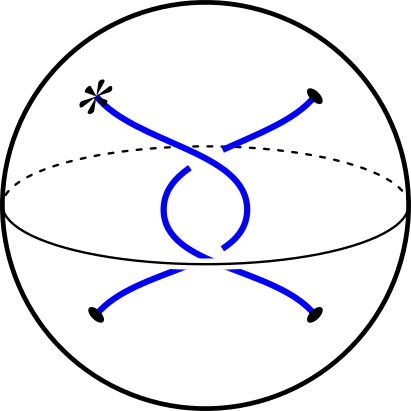
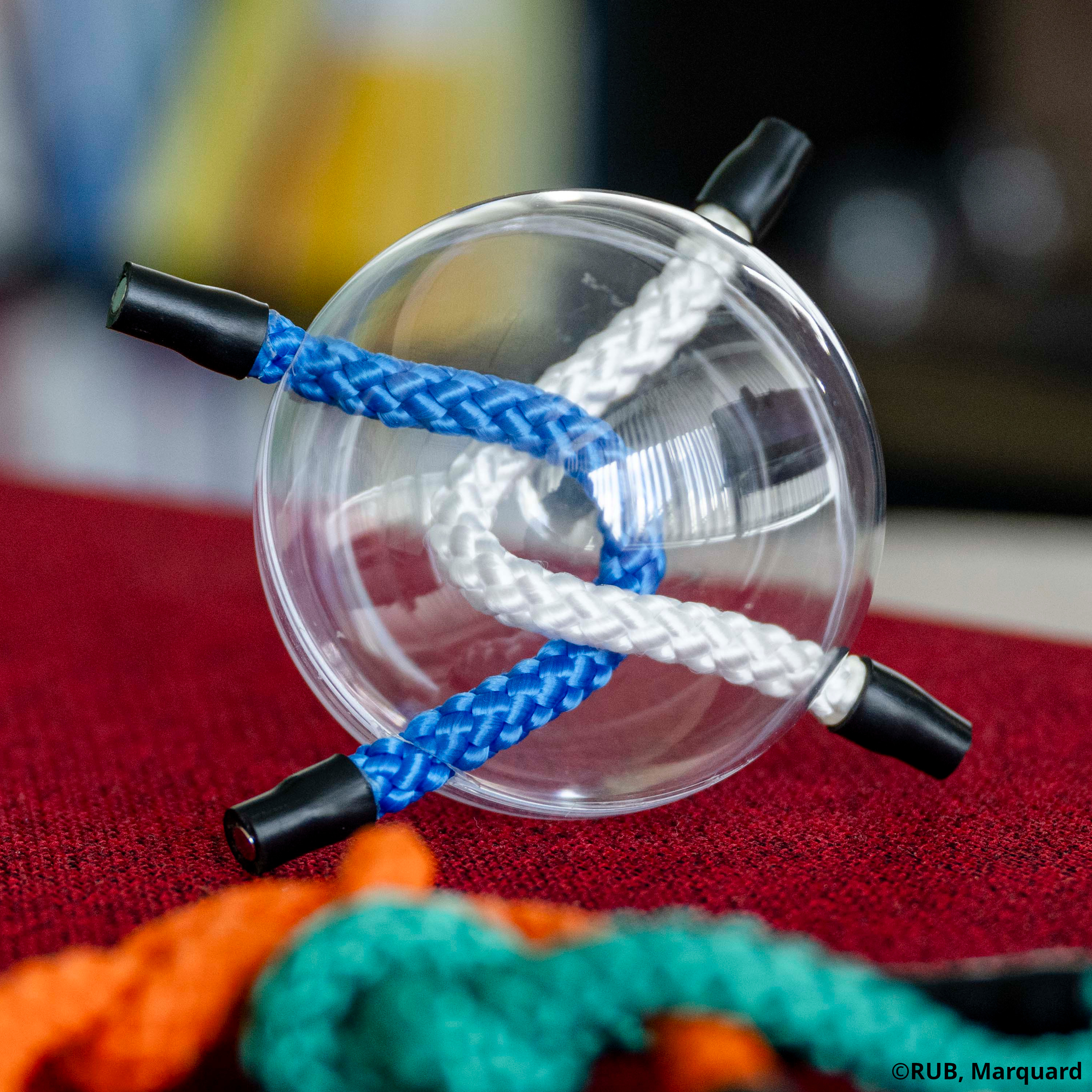
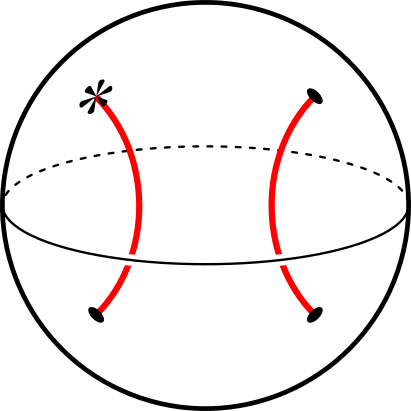
Tangles can be considered as local versions of knots. More precisely, a Conway tangle is a smooth embedding of two arcs into a three-dimensional ball such that the endpoints lie on the boundary, considered up to smooth deformation fixing the boundary. An example is shown in the photo above and again on the right. This particular tangle has the special property that, by allowing the endpoints to move on the boundary sphere, the two arcs can be untangled, that is, smoothly deformed into two trivially embedded arcs (shown in red). Tangles with this property are called rational tangles.
A Theorem of the English mathematician John Conway (1937–2020) says that rational tangles are classified by lines in the 2-dimensional plane of rational slope, or slope (\infty).
Conway's original proof of the theorem uses the close connection between rational tangles and continued fractions. But there is also the following, more geometric approach. Consider the two-dimensional plane with the following chessboard pattern:
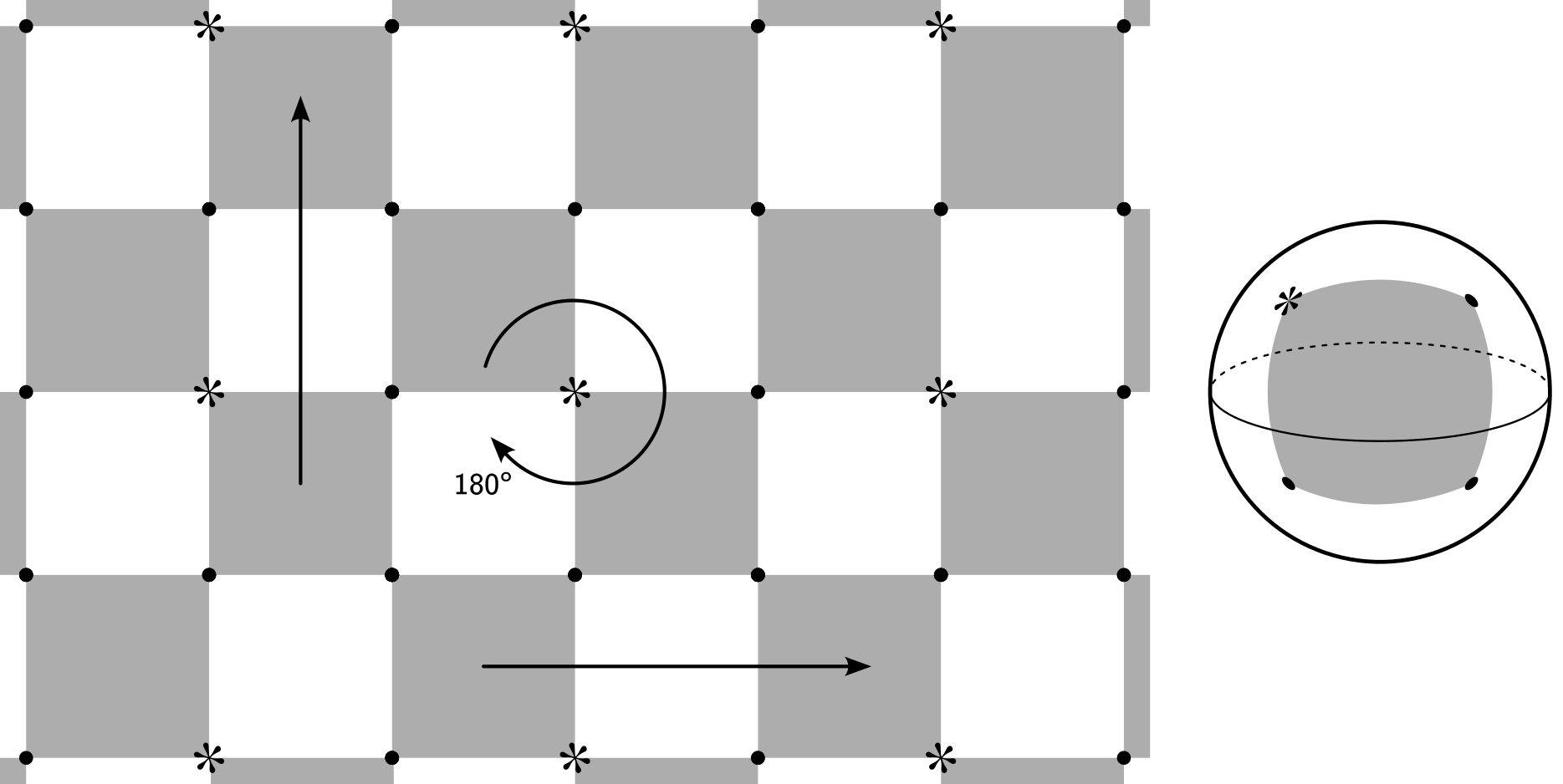
Shifting the plane up by two units preserves the chessboard pattern. So does shifting the plane right by two units and rotation about the origin (∗). The quotient space of this action is the sphere shown on the right. (Topologists say the chessboard is the planar branched cover of the sphere with four branch points.) Moving the three endpoints • on the sphere while fixing the fourth point ∗ corresponds to a linear transformation of the plane, and vice versa. (For the experts: This realizes the isomorphism between the group (\operatorname{PSL}(2,\mathbb{Z})) with the quotient of the braid group on three strands by its centre.)
We now turn to the proof of the theorem, starting with the trivial Conway tangle shown on the right:
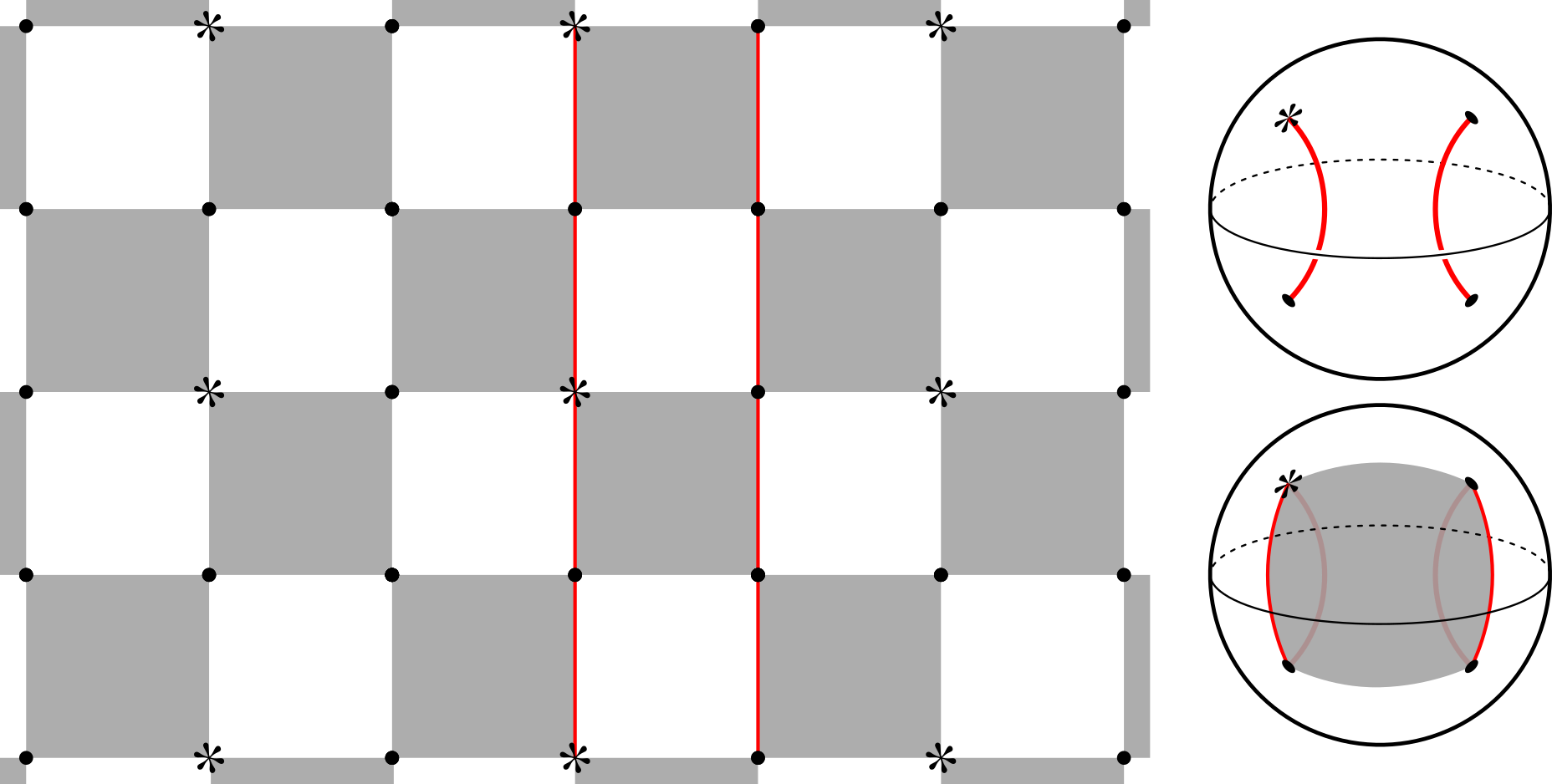
Its two arcs can be pushed to the boundary sphere, which lift to vertical straight lines in the planar cover. Similarly, we can push the arcs of any rational Conway tangle to the boundary. A Lemma from covering space theory (Topology I) tells us that we can always lift them to the planar cover:
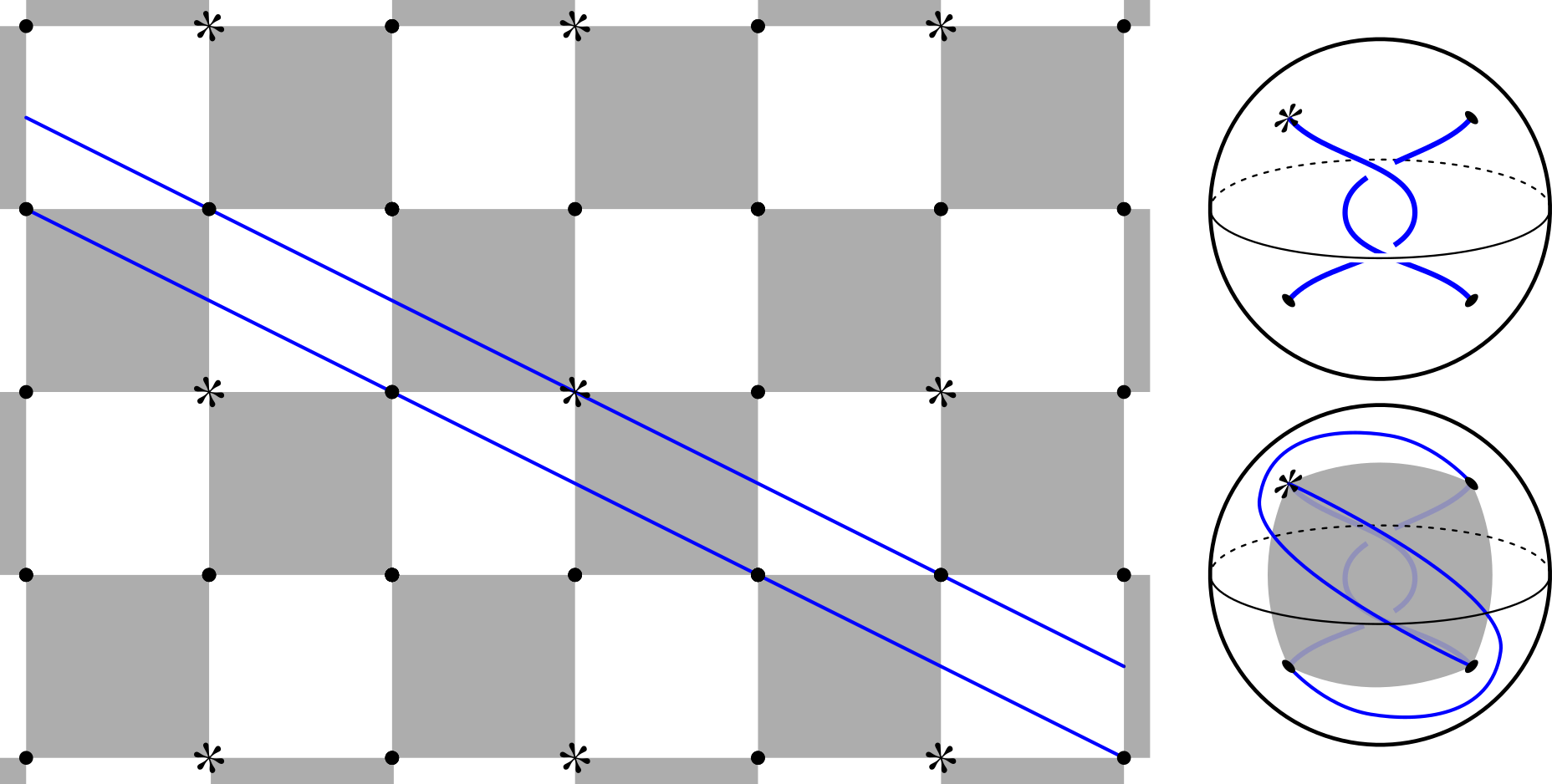
Since twisting on the sphere corresponds to a linear transformation in the cover, these lifts are straight lines of some rational slope. This shows one direction of the theorem. We leave the converse as an exercise to the reader.
Conway tangles are an area of active research, for example because of their role in knot mutation. Modern homological tools like knot Floer homology or Khovanov homology can, for instance, distinguish rational tangles from all other Conway tangles.
Further Reading
Ein mathematischer Knoten ist eine glatte Einbettung eines Kreises in den dreidimensionalen Raum, die bis auf glatte Deformationen betrachtet wird. Das physikalische Modell eines Knotens ist ein kreisförmiges Stück Seil, das im dreidimensionalen Raum verknotet ist.
Tangles können als lokale Versionen von Knoten betrachtet werden. Genauer gesagt ist ein Conway-Tangle eine glatte Einbettung von zwei Intervallen in eine dreidimensionale Kugel, wobei die Endpunkte auf dem Rand liegen müssen. Conway-Tangles werden bis auf glatte Deformationen betrachtet, die die Endpunkte fixieren. Ein Beispiel ist auf dem Foto oben und ebenfalls auf der rechten Seite zu sehen. Dieses spezielle Tangle hat die besondere Eigenschaft, dass die beiden Tanglestränge entwirrt, d.h. glatt in zwei trivial eingebettete Intervalle (rot dargestellt) verformt werden können, wenn man den Endpunkten auf der Sphäre erlaubt, sich frei auf der Sphäre zu bewegen. Tangles mit dieser Eigenschaft werden als rationale Tangles bezeichnet.
Ein Theorem des englischen Mathematikers John Conway (1937–2020) besagt, dass rationale Tangles durch Geraden in der zweidimensionalen Ebene mit rationaler Steigung oder Steigung (\infty) klassifiziert werden.
Conways ursprünglicher Beweis des Satzes nutzt die enge Verbindung zwischen rationalen Tangles und Kettenbrüchen. Es gibt jedoch auch einen geometrischen Ansatz. Betrachten wir dazu die zweidimensionale Ebene mit dem folgenden Schachbrettmuster:
Durch Verschieben der Ebene um zwei Einheiten nach oben bleibt das Schachbrettmuster erhalten. Das Gleiche gilt für eine Verschiebung der Ebene um zwei Einheiten nach rechts und eine Drehung um den Ursprung (∗) um 180°. Der Quotientenraum dieser Aktion ist die rechts abgebildete Kugel. (Topologen sagen, dass die Ebene mit dem Schachbrettmuster die ebene verzweigte Überlagerung der Kugel mit vier Verzweigungspunkten ist.) Verschiebungen der drei Endpunkte • auf der Kugel (den vierten Punkt ∗ können wir o.B.d.A. festhalten) entsprechen linearen Transformation der Ebene und umgekehrt. (Für Experten: Dies realisiert die Isomorphie zwischen der Gruppe (\operatorname{PSL}(2,\mathbb{Z})) und dem Quotienten der Zopfgruppe auf drei Strängen modulo ihrem Zentrum.)
Wir wenden uns nun dem Beweis des Satzes zu und beginnen mit dem trivialen Conway-Tangle, das rechts dargestellt ist:
Drücken wir die beiden Tanglestränge auf die Randsphäre, so erhalten wir zwei eingebettete Kurven, die sich zu vertikalen Geraden in der planaren Überdeckung hochheben lassen. Das gleiche können wir mit den Strängen eines jeden rationalen Conway-Tangles machen. Wir erhalten wiederum zwei eingebettete Kurven in der Sphäre. Nach einem Lemma aus der Überlagerungstheorie (Topologie-I-Vorlesung) lassen sich diese Kurven stets zu Kurven in der in der Ebene hochheben:
Da Selbstabbildungen der Kugel linearen Transformation in der Überdeckung entsprechen, sind diese Kurven homotopy zu Geraden mit einer rationalen Steigung. Dies zeigt eine Richtung des Satzes. Die Umkehrung lassen wir dem Leser als Übung.
Conway-Tangles sind ein aktives Forschungsgebiet, beispielsweise aufgrund ihrer Rolle bei der Knotenmutation. Mit modernen homologischen Werkzeugen wie Knoten-Floer-Homologie oder Khovanov-Homologie können wir rationale Tangles von allen anderen Conway-Tangles unterscheiden.
Weiterführende Literatur